
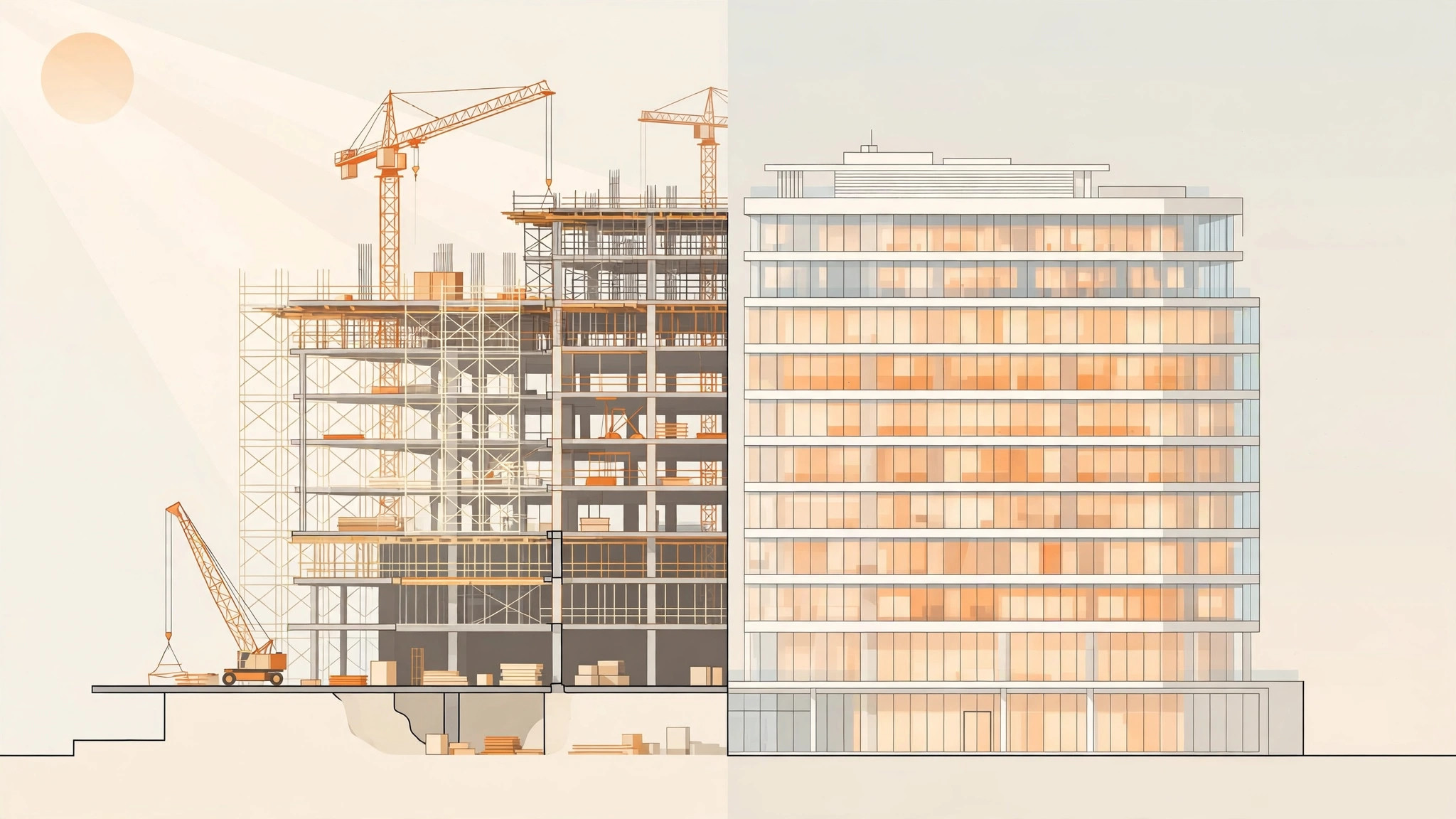
In Dubai's commercial market, you can buy an income-producing asset in two very different states: off-plan, where the building is still on the drawing board or under construction, or tenanted, where the property exists and someone is already paying rent. Both can work in a shared-ownership structure. They just suit very different temperaments.
What off-plan actually means for your money
With off-plan, your capital goes in before there is any rental income. You are buying at an earlier price point, paying in stages as construction progresses, and waiting — sometimes a year, sometimes longer — before the first dirham of rent arrives. The attraction is straightforward: early-stage pricing and the chance to hold an asset that may be worth more once it is completed and leased.
The trade-off is equally straightforward. Delays happen. Handover dates slip. The tenant you imagined may not materialise at the rent you imagined. In a shared-ownership setup, this means the group's money is committed but not yet productive, and the platform's job is to keep every co-owner informed about construction progress rather than sending them monthly income.
What tenanted means for your money
A tenanted asset flips the equation. There is a lease in place, a tenant paying rent, and a service-charge history you can actually read. Instead of modelling what income might look like, you can see what it does look like: the rent roll, the occupancy record, the operating costs. That visibility is the main reason many shared-ownership investors prefer tenanted buildings.
The compromise is price. Income-producing assets usually cost more than off-plan ones of comparable size, because the income stream is already proven. You are paying for certainty, and certainty has a price. You also inherit the tenant — their payment record, their lease terms, and the remaining length of their contract.
The real comparison: risk sits in different places
Neither option is inherently safer; the risk just lives in a different part of the timeline:
- Off-plan risk is front-loaded: construction delays, developer issues, and the gap between projected and actual rents at handover.
- Tenanted risk is ongoing: the tenant may leave at lease end, the building may need capital works, and service charges may rise.
- Cash flow timing differs: tenanted assets can distribute sooner; off-plan assets distribute only after completion and leasing.
- Exit liquidity differs too: selling a share in a completed, income-producing asset is generally easier to explain to a buyer than selling one in a half-built tower.
Which suits shared ownership better?
Shared ownership amplifies the strengths of both. It lets a group of investors access a tenanted commercial unit that none of them could buy alone, or pool capital into an off-plan opportunity with staged payments that match construction milestones. The platform's role in both cases is the same: verify the facts, document everything, and keep the money's path transparent.
As a rule of thumb, investors who want to see income early tend toward tenanted assets, while those comfortable waiting for a completion story lean toward off-plan. The honest move is to match the asset type to your own timeline — not to someone else's pitch.
Capital at risk. Educational content, not financial advice.
See the journey live.
Tour the demo investor portal — reservations, payments, register.
Play portal demo